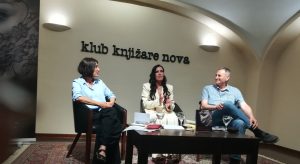
Nora King – Between Women’s Writing, Literature, and Conversation
 There are stories that emerge from the need to say something. And then there are those that emerge from the need to finally speak with our own voice.
It is precisely within this space that the literary work of Nora King can be explored. As an author, she examines themes of identity, relationships, placement, and the inner world of women, creating a space in which the female experience is not a secondary theme, but the starting point from which the story unfolds.
Her literary work currently made of nine novels focusing on female narrators, includes the novel The Tenant as well as the book Noblesse Oblige, available to the international audience on Amazon. Aside from writing, Nora King also develops her relationship with literature and storytelling through the podcast Smitten in Written, expanding her creative expression beyond the traditional form of the book and into the realm of conversation, ideas, and contemporary storytelling culture.
Women’s Writing as a Space of Freedom
When we speak of women’s writing, we are not simply talking about literature written by women. We are talking about a space in which a woman has the right to shape her own experience in her own words, from her own perspective, without having to shrink or adjust to someone else’s expectations.
Women’s writing opens the door to themes that for a long time remained on the margins of literary attention: everyday life, family, intimate relationships, emotional upheaval, the feeling of not belonging, the search for one’s own identity, as well as the quiet strength through which women continually rebuild themselves and their lives.
In this context, Nora King’s work belongs to the contemporary landscape of women’s storytelling—a space in which the female character is not merely an observer of her own story, but its protagonist.
She feels, questions, makes mistakes, chooses, leaves, returns, and finds herself again.
The Tenant– Between Space and Belonging
The title The Tenant immediately raises an intriguing question: what does it mean to be a tenant?
The question can be understood literally, but also metaphorically. A person can sometimes be a tenant in a space they call home, in a relationship they inhabit, or even in their own life.
For a woman, this can mean living within roles assigned to her, expectations she has accepted, or relationships in which her own voice has gradually subsided.
This is why literature can become a space of liberation. On the pages of a book, a woman no longer has to be what is expected of her. She can simply be who she is.
From Book to International Audience
Nora King’s journey as an author does not end with a single book or a single literary form.
The book Noblesse Oblige, available through Amazon, represents another step toward an international audience and a broader readership. In this way, writing crosses the boundaries of language and the local literary landscape, reaching readers who can recognize different experiences within universal themes of identity, relationships, emotions, and personal choice.
This openness to different audiences is particularly important for a contemporary author: literature no longer exists only on a single shelf, in a single bookstore, or within a single language. A story can find its way much further.
Smitten in Written – When Writing Becomes Conversation
A special place in Nora King’s creative work is occupied by the podcast Smitten in Written.
If a book is a space in which an author speaks, a podcast is a space in which that voice can meet other voices.
Smitten in Written therefore expands the idea of literature beyond the written page itself. Writing becomes conversation, an exchange of ideas, and a way of connecting with the audience.
At a time when the ways in which we experience and consume literature are changing, formats such as these allow authors to bring their stories and perspectives closer to audiences in new ways.
A Voice That Belongs to the Author
One of the most important values of women’s writing is the right to have one’s own voice.
Throughout history, women have often been present in literature, but they have not always had equal opportunities to define their own stories. The contemporary female author takes on that role: she does not wait for someone else to describe her. She writes.
Through her various creative projects, Nora King is building precisely this space—between the book and conversation, between personal experience and universal themes, between the author’s intimate voice and the reader who discovers something of their own within the story.
Because women’s writing is not simply a question of literary genre.
It is a question of perspective.
A question of the right for one’s own experience to be worthy of a story.
And perhaps most importantly, a question of having the courage to tell one’s own story in one’s own voice.
Nora King is building her journey as an author through precisely that voice—through books, through an international readership, and through a conversation that continues even after the final page.